Invoicing
What to do when a client disputes your hours
Most disputed hours are a surprised client, not an accusation. What to reply the same day, what to send, when to give ground, and how to make the next dispute unlikely.

8 min read
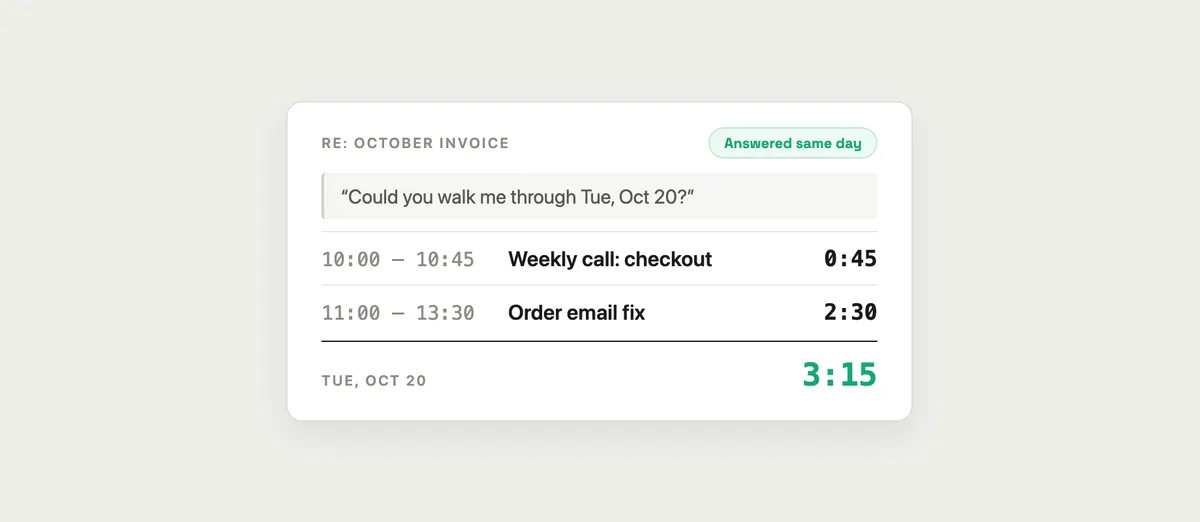
Table of contents
The email arrives a day after the invoice. It might be blunt, “this seems like a lot of hours”, or careful, “could you walk me through the breakdown?” Either way it lands like an accusation, and the first instinct is to defend every hour at once. That instinct is the most expensive part of most disputes.
Nearly every question about hours is one of a handful of situations wearing the same words. Work out which one you are in before you answer the substance, because the right reply is different for each, and the wrong one can turn a ten-minute question into a lost client.
Work out which dispute you have
- A surprised client. By far the most common. The total is higher than they expected, and nothing told them it was coming. They do not doubt the work; they doubt the number.
- A doubted line. One session or one day looks wrong to them: a call billed at an hour that they remember as twenty minutes, or two days on something they thought was small.
- A budget problem. The hours are fine, but the money is not. The project ran past what they planned for, and the invoice is where they found out.
- A scope disagreement. They think some of the work was included, or was never asked for. This is a dispute about the agreement, not the hours, and no record of time will settle it.
- A real mistake. A session left running over lunch, a day billed twice, the wrong rate. It happens to everyone who bills by the hour.
- Bad faith. A client who has decided not to pay and is looking for a reason. Rare, and usually obvious by the second message.
The first four have something in common: the client is not saying you lied. Treating them as if they were is how a fixable conversation becomes a fight.
Answer the same day, before you have the answer
The first reply is not the breakdown. It is the signal that the question was heard and will be answered properly. Send it the same day, short, and without any defense of the hours:
“Thanks for flagging this. Which days or lines would you like to go through? I’ll send the sessions behind them by Thursday, and I’m happy to walk through it on a call if that’s easier.”
Three things are doing the work there. Asking which lines narrows a vague worry into something specific you can answer. A date shows you are not stalling. And the offer of a call tells the client you are comfortable with them looking closely, which is most of the reassurance they wanted.
What not to send: a long account of how hard the work was, a reminder of the agreed rate, or the whole month’s record. Each of those answers a question nobody asked, and makes the reply read as defensive.
Send the days in question, not the month
When the client names the lines, open your record for those days only. For each session, send:
- the date, the start and end, and how long it ran,
- what it was for, in the words the client would use,
- and what sits behind it: screenshots or activity if you keep them, the commit, the file, the message thread.
Keep it to what was asked. A focused reply about three days is easy to read and easy to accept. The same three days buried in a month of timestamps looks like you are hoping they give up reading.
If they did not name lines, send the period grouped by area of work, with the hours for each, and offer the sessions behind any of them. Most surprised clients need nothing more than to see that the total is made of five recognizable pieces of work.
Fix real mistakes in full
Sometimes the client is right. The timer ran through lunch, a session was entered twice, a day carried the wrong rate. When the record shows a mistake, correct it in full, say so plainly, and send the revised invoice in the same message. No caveats.
This costs an hour or two of billing and buys something worth far more: proof that your records are checked, and that you correct them against yourself as readily as in your favor. Every future invoice is easier to accept because of it.
The same applies to a mistake the client did not spot. Correcting it unprompted is the cheapest trust you will ever buy.
Give ground only for a reason you can name
When the record is right, the hours stand. But a dispute is a negotiation about a relationship as much as about an invoice, and sometimes giving something is the better trade.
A goodwill credit makes sense when the client was genuinely blindsided, for example when the project ran well past an estimate and nobody warned them in time. Then part of the surprise is yours, even though every hour was worked. Credit a portion, call it a goodwill credit in writing, and say why: the hours are accurate, but you should have flagged earlier that the work had passed the estimate.
What to avoid is splitting the difference to make the discomfort stop. An unexplained discount teaches the client that disputing works, and quietly concedes that the hours were not real. If you give ground, give it for a reason, and put the reason in the same sentence.
Scope disagreements need a different answer entirely. Point to the agreement, not the timesheet, and decide whether the disputed work is something you absorb this once or something you bill. Then write the scope down properly before the next piece of work starts.
When the client will not pay
A few disputes do not end with the breakdown. If a client has seen the record and still refuses, stop starting new work for them first. Hours added to an unpaid balance only raise the stakes.
Then put everything in one written message: the invoice, the amount outstanding, the days and sessions behind it, what has already been corrected, and a date by which you expect payment. Calm, factual, no adjectives. Most refusals end here, because a clear record and a clear date leave very little room.
If it still does not end, the options depend on your contract and where you both are: late fees if the contract has them, a collections service, small claims, or a lawyer’s letter for larger amounts. They are slow and they end the relationship, so they are worth it only when the amount is worth the time. On a platform like Upwork the process is the platform’s own: respond within its deadline, because silence counts against you, and the tracker’s record is what the review reads.
Make the next dispute unlikely
Almost every dispute is a surprise that arrived with the invoice. The prevention is making sure nothing on an invoice is ever news.
- Send a short report on a rhythm. Weekly works for most hourly work: the total, and the hours grouped by area of work. A client who has read four weekly reports is not surprised by the monthly invoice.
- Agree a threshold. Where there is an estimate, agree that you will flag it when the work passes most of it, say 80 percent, before carrying on. Budget disputes mostly disappear.
- Keep the record as you work. Sessions with real start and end times and a note in the client’s words, written at the time. A record made while working ends a dispute in one email; a record rebuilt for the dispute starts a second argument.
- Build the invoice from the same record. If the reports and the invoice come from the same hours, the invoice holds no number the client has not already seen.
A dispute is a question, most of the time
Clients who question hours are usually asking for one thing: to understand what they are paying for. A fast reply, the days in question, an honest correction where one is due, and a rhythm of reports that means the next invoice holds no news. That answers the question, keeps the client, and in most cases is the last time the question comes up.
Try ProofHour with your next client.
Reports and invoices from one record. Free for 30 days, no card.
Questions people ask
How do I respond when a client says I billed too many hours?
Reply the same day, without defending the hours yet. Thank them for raising it, ask which days or lines they mean, and say when they will have the detail. Then send the sessions behind those days only, each with its times and what it was for, and offer to go through it together.
Should I give a discount when a client disputes my hours?
Only for a reason you can name. Correct real mistakes in full and without argument. Where the record is right but the client was blindsided, a goodwill credit can be worth more than the hours, as long as you call it that in writing and it does not read as an admission that the hours were not worked.
What can I do if a client refuses to pay for hours worked?
Stop starting new work, then put the invoice, the amount, the record behind it and a payment date in one written message. Most refusals end there. Beyond that, the options depend on your contract and where you both are, from late fees to a collections service or small claims, and they are worth it only when the amount justifies the time.