Freelancing
A work diary for direct clients
When a client moves off Upwork, the work diary disappears with the platform. What the diary actually did, which parts are worth keeping for direct work, and which parts to leave behind.

7 min read
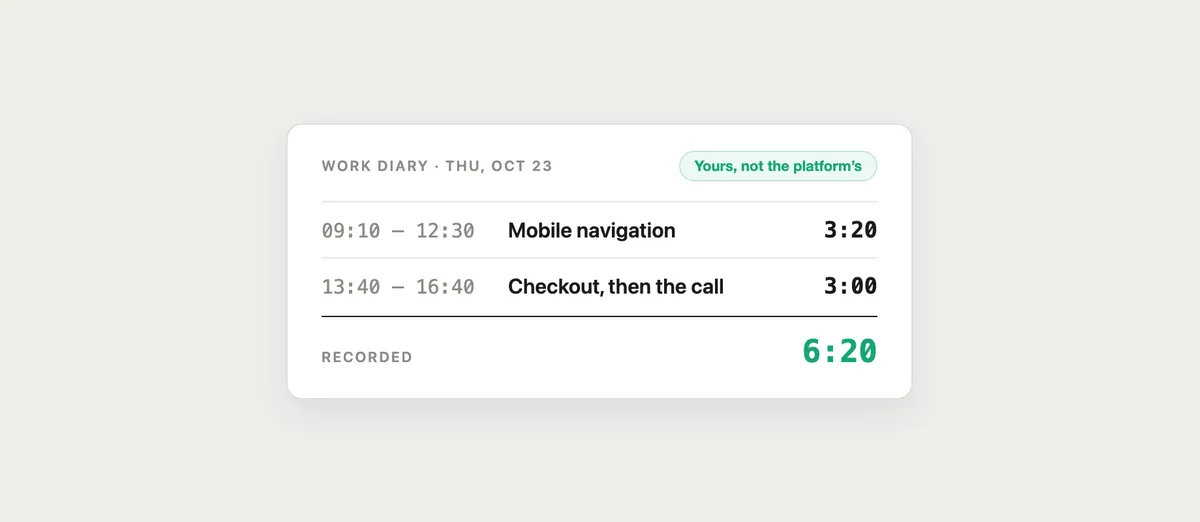
Table of contents
Moving a client off Upwork is usually good news. The relationship has outgrown the platform, the fee stops making sense, and both of you would rather work directly. Then the first direct invoice goes out, and something is quietly missing. On the platform, every billed hour sat in a work diary the client could open: screenshots through each session, activity levels, a memo saying what the time was for. Nobody looked at it much. But it was there, and both sides knew it was there, and that knowledge did a lot of silent work.
Direct, there is no diary. There is an invoice, a number, and your word. Most client relationships survive that fine, right up until a total surprises someone, and then you discover what the diary had been doing all along: making the question “what is this number made of” answerable in one click instead of one awkward email thread.
The fix is not to miss the platform. It is to notice which parts of the diary were genuinely useful, keep those, and drop the parts that only ever served the platform.
What the work diary actually did
Strip away the interface and Upwork’s diary did three things.
- It recorded time as it happened. The tracker wrote hours in ten-minute segments while you worked, so the total on the invoice was a sum of real intervals, not a reconstruction typed the night before billing.
- It attached evidence to the hours. Screenshots a few times an hour and an activity level per segment meant any hour could be opened and looked at, which is a different kind of claim than a line in a timesheet.
- It gave both sides the same view. The client did not have to ask for the record, and you did not have to decide what to send. It was simply visible, which kept the question from ever becoming a confrontation.
The third one is the part people underestimate. A record that exists before anyone asks for it reads as a record. Anything assembled after the question arrives reads as a defense, however honest it is.
What changes when you go direct
Two things disappear with the platform, and only one of them is a loss.
The loss is the shared record itself. Hourly protection, the dispute process, the diary a client could open, all of that was platform furniture, and it stays behind. Keeping a record is now your job, and so is giving the client a view of it. If you do neither, hourly billing becomes exactly what it was before these tools existed: an invoice and a negotiation.
The other disappearance is the platform’s terms. On Upwork, the record belonged to the contract. The screenshots were taken on the platform’s schedule, kept on the platform’s servers, and used in the platform’s dispute process. Direct, the record is yours. You decide what gets captured, where it lives, and what the client sees. That is not a consolation prize. It is the better half of the deal, and it is worth setting up deliberately instead of recreating the surveillance version by habit.
The parts worth keeping
A direct-client work diary needs four things, and none of them require a platform.
- Sessions, recorded live. Start and end times written while the work happens, or just after each session. This is the habit everything else rests on, and the one that cannot be faked later, because records made in the moment have a texture that reconstructions never do: the 9:12 start, the 23-minute session, the afternoon a bug ate.
- A note per session, in the client’s words. “Checkout validation” settles questions. “Dev work” invites them. The test is whether the client would recognize the phrase from their own brief.
- Evidence where the work allows it. Screenshots and activity through a session turn “did you work these hours” into “here is each hour, look for yourself”, and that second conversation is short. Calls and offline work go in by hand with a note saying what they were for, because hours that only ever appear at invoice time are the ones that get questioned.
- A report the client actually receives. This replaces the diary’s shared view. A short summary on a steady rhythm, weekly works for most retainers, with the hours grouped by what the time went into. By the time the invoice arrives, it holds no news, and an invoice that holds no news gets paid.
If you already keep the first two and send the fourth, you have most of the diary’s value. The third is what ends the rare dispute quickly instead of slowly.
The parts to leave behind
Do not rebuild the parts of the diary that existed for the platform rather than for you.
You do not need the ten-minute activity score as a performance metric. Off the platform, nobody is averaging your keystrokes, and a good note per session carries more information than any activity percentage.
You do not need to capture everything by default or hand the client a live feed. The diary’s lesson is that evidence should exist before questions do, not that a client needs to watch you work. A record you keep, with a summary you send and detail you can open on request, gives the client everything the diary gave them, without putting your screen under someone else’s terms.
And you do not need anyone’s dispute process. Direct, the record is the dispute process. A same-day reply with the sessions for the days in question, what each was for, and what sits behind them resolves almost every question, because most clients were never claiming you lied. They were surprised by a total, and watching it break into twenty real sessions dissolves the surprise.
Setting it up with the client
The diary worked partly because nobody had to propose it; it came with the contract. Direct, you propose it, and the proposal is one paragraph in your first email: hours are recorded as I work, you get a short report every Friday with the hours grouped by what they went into, and the invoice is built from the same record, so any line on it can be opened up if you ever want to see the detail.
Clients coming off Upwork accept this instantly, because it is the arrangement they already had, minus the fee and the surveillance framing. New direct clients accept it because it answers the question they were too polite to ask. Either way, the agreement costs you nothing you were not already doing and buys the thing the platform used to provide: a number both sides can trust without discussing it.
The diary was never the platform’s feature
It is easy to file the work diary under things Upwork does, but it is really a feature of hourly work itself: whenever one person bills another by the hour, both are better off when the hours carry their own evidence. The platforms industrialized that idea and charged a commission on it. Working direct, you keep the idea, drop the commission, and get to run it on your own terms, which is how it should have worked all along.
Try ProofHour with your next client.
Reports and invoices from one record. Free for 30 days, no card.
Questions people ask
Can I use Upwork’s time tracker for clients outside Upwork?
No. The work diary exists only inside an Upwork hourly contract, and the desktop tracker records into that contract. For a direct client you need your own record, kept with a tool you choose, and shared on terms the two of you agree.
What should a work diary for a direct client include?
Sessions with a real start and end, a short note per session in words the client would recognize, evidence behind the hours where the work allows it, and a regular report the client can open without creating an account. The invoice should be built from the same record the reports came from.
Do direct clients expect screenshots the way Upwork takes them?
Usually not, and nothing forces the Upwork pattern on direct work. Screenshots are worth keeping where trust is still being built, but off the platform they are your record first, captured for your own protection and shared when a question actually arrives.