Freelancing
How to prove hours worked to a client
Proof is a record made while you worked, not one written for the argument. What a convincing record holds, what to send when a client asks, and how to stop the question arriving at all.

6 min read
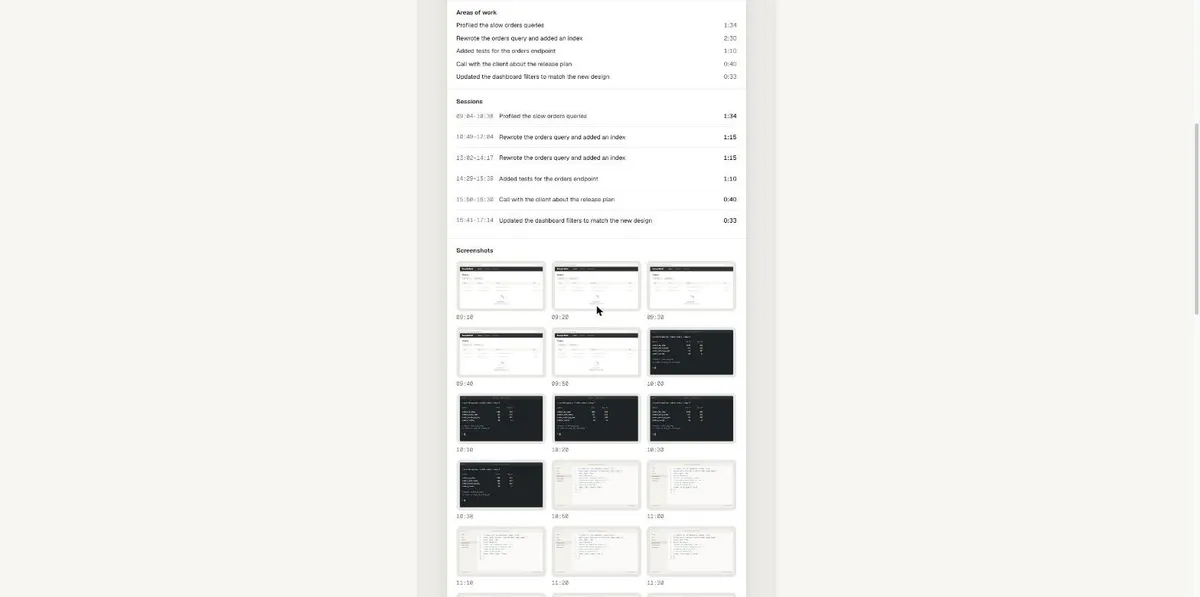
Table of contents
The question usually arrives with the invoice. Not always as an accusation, often just a line in an email: can you break down these hours? And the honest answer, that you were at your desk doing the work, convinces nobody, including clients who believe you. They are not asking whether you worked. They are asking what the number on the invoice is made of.
How well that moment goes is decided weeks earlier. Proof of hours is not something you produce when asked. It is something you either have, because it was made while you worked, or do not have, because it now has to be reconstructed from memory, a calendar and a commit log. The first reads as a record. The second reads as a story.
Proof is made while you work, not after
A client weighing a breakdown is really weighing one thing: was this written down at the time, or assembled for me now? A timesheet typed the night before the invoice has round numbers, tidy blocks and no texture, because memory works that way. A record that grew while the work happened has a 9:12 start, a session that ran 23 minutes, a note about the bug that ate an afternoon. Nobody invents that level of detail, and clients know it.
This is why the habit matters more than the tool. Whatever you use, a timer, a tracker, a plain text file, the entry has to be made as the work happens or just after each session. A record kept that way is boring to produce and very hard to argue with. A record produced for the argument is neither.
What a convincing record holds
Three things, for every working session:
- When it started and when it ended, so the hours are sums of real intervals rather than estimates.
- What it was for, in words the client would recognize from their own brief. “Checkout validation” settles a question; “misc dev work” invites one.
- Where the work allows it, something behind the hours: the screen as it looked while you worked, activity through the session, the thing that got finished.
The third is the one freelancers skip, and the one that ends disputes rather than prolonging them. Times and notes say what you did. Evidence shows it. A screenshot of the editor open on the client’s project at 14:40 is not a claim, it is a fact, and facts do not escalate.
Calls and meetings belong in the record too, entered by hand with what they were for. Hours that only appear at invoice time are the ones that get questioned, and meetings are the usual culprit.
Send the summary, keep the record
Having a detailed record does not mean sending one. A client asking about hours wants to see what the money bought, grouped by the work: the checkout, the new pages, the calls, each with its hours. That fits on half a page. The sessions, timestamps and evidence behind it stay in your record, ready for the day a specific number is challenged.
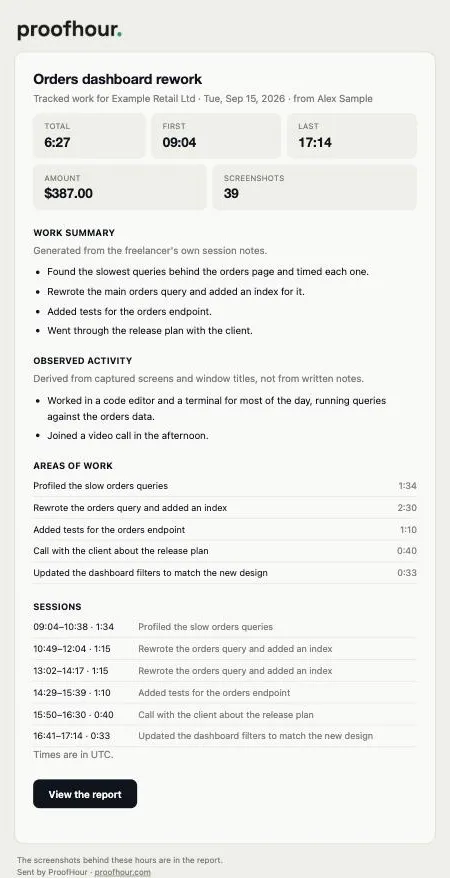
Sending everything by default has the opposite of the intended effect. A wall of timestamps reads as noise, and noise makes a reader suspicious of the parts that matter. Show the shape of the work; hold the detail in reserve. The reserve is what makes the summary credible, because any line in it can be opened up on request.
When a client disputes the hours
Answer quickly, even if the full breakdown takes longer. A same-day reply saying you are pulling the detail together does more for trust than a perfect document three days later, because a fast, calm answer is itself evidence of someone with nothing to hide.
Then open the record for the days in question only:
- each session, with its start, end and length,
- what each was for,
- and whatever sits behind it, screenshots, activity, the work itself.
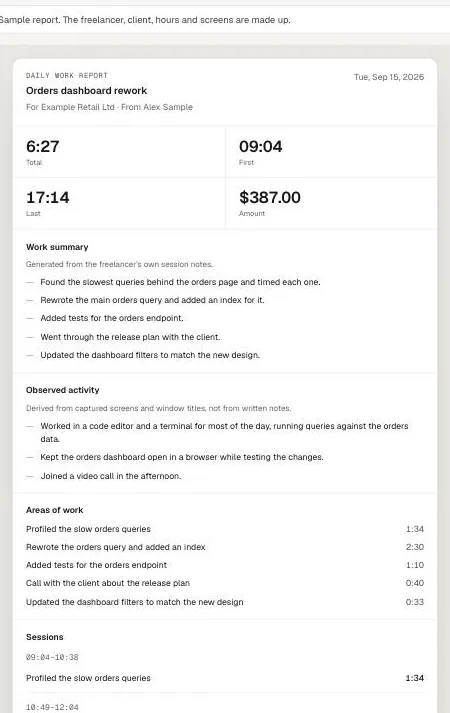
Walk through it together if the client wants to. Do not pad the reply with justification; the record is the reply. In most disputes the client is not claiming you lied, they are surprised by a total, and watching it resolve into twenty real sessions with real notes is what dissolves the surprise.
If you have no record, you have a different problem, and the honest move is usually to settle the disputed hours and start keeping one. One written-off invoice teaches the habit permanently.
Screenshots, and when they are worth it
Screenshots sit at the uncomfortable end of proof: the most convincing kind, and the most invasive to produce. Whether they are worth it depends on where the trust currently is. An ongoing client of three years rarely needs them. A new client, remote hourly work, an agency billing on your behalf, anywhere a dispute would otherwise be your word against theirs, is where they earn their keep.
The point of capturing them is not surveillance of yourself. It is that the question changes from “did you work these hours” to “here is each hour, look for yourself”, and that second conversation is short. Most freelancers who track with screenshots never send most of them. Their value is that they exist, attached to the hours, before anyone asked.
The proof nobody asks for
The freelancers who are never asked to prove their hours are not the lucky ones, they are the ones whose clients already know what the hours were spent on, because a short report has been arriving on the same day every week since the work began. By the time the invoice comes, it holds no news.
That is the real order of operations. The record protects you in a dispute, but the rhythm prevents the dispute, and both come from the same habit: write down what the time went into while it is going there. Everything else, the breakdowns, the evidence, the calm reply, falls out of that for free.
Try ProofHour with your next client.
Reports and invoices from one record. Free for 30 days, no card.
Questions people ask
What counts as proof of hours worked?
A record made while the work happened. Sessions with a start and an end, a note in the client’s own words for what each one was for, and evidence behind the hours where the work allows it. A timesheet written the night before the invoice is a reconstruction, and clients can tell.
Do I need screenshots to prove my hours?
Not always. A consistent record of sessions and notes settles most questions on its own. Screenshots matter most where trust is still being built, on a new client, remote hourly work, or anywhere a dispute would be your word against theirs.
What should I send when a client disputes an invoice?
The days in question, not everything. For each one, the sessions with their times, what each was for, and the evidence behind them. Answer within a day, even if the full breakdown takes longer, and offer to walk through it together.